 Roomit
Find a Match in 30 Days: 12 Item Household Compatibility Checklist
A household compatibility checklist is a structured set of scenario-based questions that surfaces how someone actually lives, not just how they describe themselves. Use it when you’re screening a new roommate or tenant, and again when you’re onboarding someone into a household that’s already running. The goal isn’t to find someone who calls themselves “clean” or “chill.” It’s to find out what that means in practice, and to write it down before move-in day, not after the first argument about dishes.
TL;DR:
- Most conflicts stem from specific issues like schedule mismatches and chore reciprocity, which are strong predictors of household friction.
- Asking detailed, scenario-based questions on cleanliness, bills, and privacy before move-in provides clearer insights than vague personality labels.
- Repeated red flags include late rent, evasive lease answers, and incompatible sleep or work schedules, requiring swift, documented intervention.
- Building a household agreement around shared values and clear procedures enhances trust and prevents misunderstandings over chores and boundaries.
- Roomitai uses detailed lifestyle compatibility criteria to match tenants, emphasizing fit over just rent and location.
Table of Contents
- The Household Compatibility Checklist: 12 Items That Actually Matter
- How to Use the Checklist: Pre-Screen, Score, Test-Run, Onboard
- Turning Checklist Answers Into a Shared Living Agreement
- Red Flags and How to Fix Them Fast
- Why Roomitai Leans on Compatibility, Not Just Listings
- What the Research Actually Tells You to Prioritize
- Finding Compatible Housemates Beyond the Checklist
- Sources
- FAQ
The Household Compatibility Checklist: 12 Items That Actually Matter
Vague labels like “easygoing” or “tidy” tell you almost nothing. A checklist built around specific scenarios does the real work, because it forces concrete answers you can compare across candidates. University of Toronto Student Life recommends exactly this approach for roommate screening, and it’s the backbone of what follows.
Here are the 12 items worth asking about, with sample scenario questions and the fields worth recording for each one:
- Cleanliness and cleaning frequency. Ask: “How often do you vacuum shared floors?” and “What’s your dish policy, same day or next morning?” Record: frequency preference, tolerance for mess, willingness to rotate chores.
- Financial arrangements. Ask: “How do you want to split rent and utilities, evenly or by room size?” and “When during the month do you pay bills?” Record: payment date, splitting method, backup plan for late income.
- Lease and occupancy details. Ask: “Is everyone on the lease, and are we allowed to sublet?” Northwestern University’s Off-Campus Life office flags this as a conversation to have before signing, not after. Record: lease names, subletting rules, notice period.
- Guest and overnight policies. Ask: “How many nights a week is a partner staying over reasonable?” Record: guest frequency tolerance, advance notice expected.
- Pets and allergies. Ask: “Are you allergic to anything, and how do you feel about a cat or dog?” Record: allergy list, pet tolerance, who cleans up after pets.
- Noise and quiet hours. Ask: “What time do you need quiet on a work night?” Record: exact hour, not “late.”
- Schedule alignment. Ask: “Do you work nights, or are you up by 6 a.m.?” Record: sleep and work rhythm.
- Shared food and item policies. Ask: “Is it fine to borrow condiments without asking?” Record: shared vs. labeled groceries, borrowing rules.
- Privacy and storage. Ask: “How do you feel about someone in your room when you’re out?” Record: closed-door norms, shared storage boundaries.
- Conflict style. Ask: “When something bothers you, do you bring it up right away or wait?” Record: preferred communication method (text, in person, house meeting).
- Expected stay length. Ask: “Are you thinking six months or a year-plus?” Record: target timeline, flexibility.
- Emergency contacts. Record: a contact number and relationship for each housemate kept somewhere visible.
The University of Tennessee at Chattanooga’s roommate agreement checklist covers most of these same categories, which tells you something: institutions that deal with roommate conflict for a living converge on the same list.
Pro Tip: “Cleanliness” is often a stand-in for consideration. Someone who answers vaguely about chores but immediately mentions who buy the toilet paper is telling you they think in terms of reciprocity, which matters more than a spotless bathroom.
One item deserves a closer look: chore reciprocity and schedule alignment. Male students report task-related conflict over cleanliness and boundaries 22% more often than female students, according to University of Toronto’s data, and schedule mismatch is notoriously hard to fix once someone’s already moved in.

How to Use the Checklist: Pre-Screen, Score, Test-Run, Onboard
The checklist works best as a repeatable process, not a one-time form. Here’s the sequence:
- Pre-screen in writing. Ask candidates to answer the 12 items by text or email before you meet. Red flags show up fast here: one-word answers, dodging the lease question, or refusing to name a monthly income range.
- Score with a simple rubric. Weight the dimensions that matter most: cleanliness 25%, finances 25%, schedule alignment 20%, guests 15%, communication style 15%. A candidate scoring 80% or higher across the board is a strong match. Anything under 60% on finances or schedule alone is worth a second conversation before moving forward, even if the total looks fine.
- Run the in-person conversation. Walk through a few scenario questions live and watch for tone, not just content. Someone who answers “I’d probably just bring it up” with hesitation is telling you something different than someone who answers it fast and specific.
- Set a 30-day trial. Treat the first month as a test run with a scheduled check-in, not a silent probation period.
- Hold the first household meeting. Walk through the checklist answers together and turn them into a written agreement everyone can see.
Pro Tip: Specificity in a reply matters more than the reply itself. “I clean the bathroom every Sunday” beats “I’m pretty clean” every time, even when both people mean well.
Turning Checklist Answers Into a Shared Living Agreement
A Shared Living Agreement isn’t a legal contract. It’s a document your household writes together and holds each other to by consensus, and it works best when everyone contributes to drafting it rather than one person handing down the rules. Boston’s housing resources office frames it exactly this way: a trust-building tool, not a legal instrument.
Build it around these sections:
- Household values and general atmosphere
- Shared spaces and boundaries (kitchen, bathroom, storage)
- Cleaning schedule and chore rotation
- Bills, payment plan, and an emergency fund for shared surprises
- Guest and overnight policy
- Pet policy and allergy accommodations
- Dispute resolution steps
- Move-out notice and subletting rules
- Signatures and a review date
Sample clauses worth borrowing: “Kitchen deep-clean rotates weekly, starting Sunday, tracked on the shared calendar.” “Rent is due by the 1st, with a $10 late fee after the 5th.” “Overnight guests require 24 hours’ notice on weeknights.”
| Agreement element | Why it matters |
|---|---|
| Cleaning rotation | Removes ambiguity about whose turn it is |
| Bill deadline and late fee | Prevents awkward reminder texts |
| Guest notice window | Protects everyone’s sense of privacy |
| Review cadence (30/90 days) | Catches small friction before it becomes resentment |
Revisit the agreement at 30 days and again at 90. Life changes, jobs shift, and an agreement that isn’t allowed to evolve tends to get quietly ignored instead.
Red Flags and How to Fix Them Fast
Some warning signs show up before move-in, and they’re worth taking seriously rather than explaining away.
- Repeated late rent payments, even small ones
- Evasive or shifting answers about who’s on the lease or whether subletting is planned
- Flat refusal to agree on basic shared rules during the initial conversation
- Extreme schedule mismatch, like a night-shift worker paired with someone who needs total silence by 9 p.m.
- Boundary violations that continue after being raised once
If a red flag shows up after move-in, address it fast with a short, specific conversation rather than a vague complaint. Document what was agreed to fix it and set a follow-up date. If the pattern repeats, bring in the leaseholder or landlord as a mediator before things escalate. When a household member consistently won’t meet basic terms, replacing them cleanly, with proper notice and a documented reason, is usually less disruptive than months of unresolved tension.
Why Roomitai Leans on Compatibility, Not Just Listings
I think most roommate searches fail for a boring reason: people screen for price and location, then hope personality works itself out. Roomitai was built on the opposite premise, that lifestyle fit deserves the same upfront attention as rent. I’ll say plainly what we don’t have: no internal satisfaction data, no client testimonials to cite here. What we do have is a process built around the same specificity this checklist demands, not vague vibes.
What the Research Actually Tells You to Prioritize
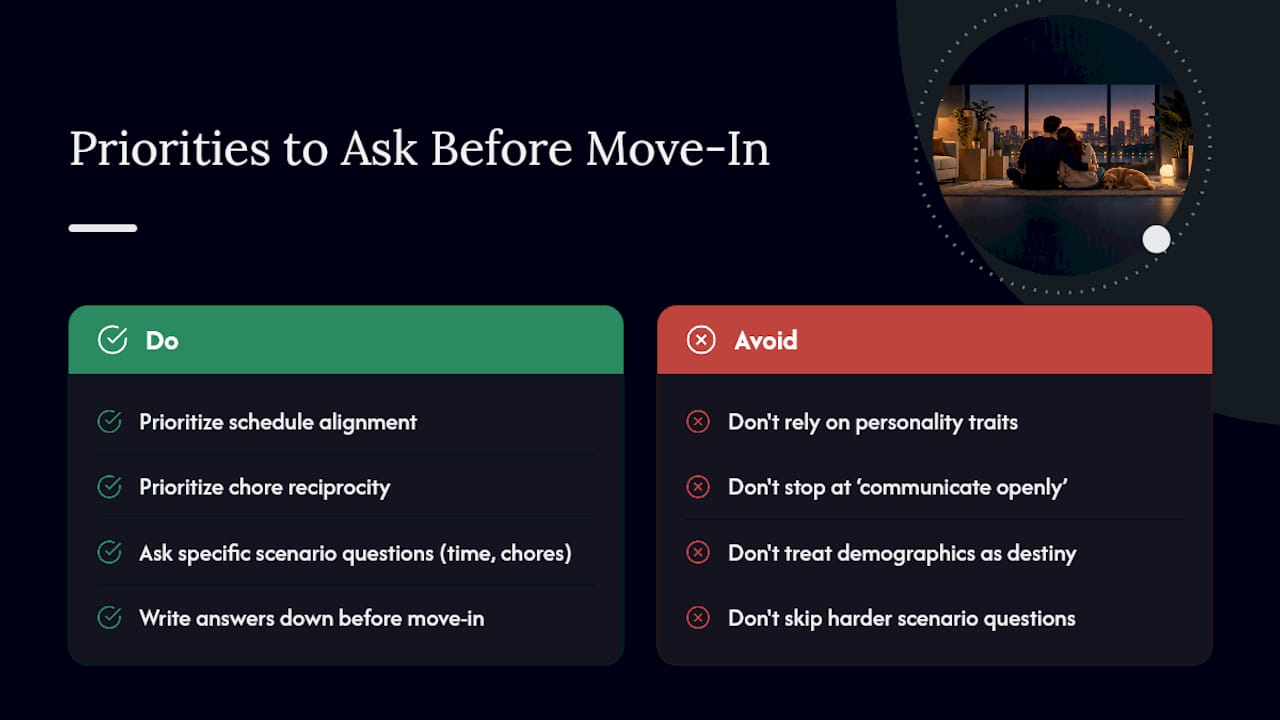
The evidence here points somewhere specific: schedule alignment and chore reciprocity predict conflict better than personality does, and demographic factors like age and education level showed the strongest links to conflict variance in a 2026 study of hostel residents. That’s a useful screening signal for life stage, but it’s not destiny, and I’d push back on anyone treating it as a shortcut to skip the harder scenario questions.
Conventional advice tends to stop at “communicate openly,” which is true and useless in the same breath. Openness without structure just means louder disagreements later. What actually works is asking about Tuesday night, not personality type: what time do you need quiet, who buys the dish soap, when exactly is rent due. If you take one thing from this checklist, make it this: write the specific answer down before move-in, not the general impression.
— Salem
Finding Compatible Housemates Beyond the Checklist
A checklist gets you organized questions. Finding someone who actually answers them well still takes searching, which is where Roomitai comes in. Roomitai is an AI-powered shared-living marketplace built around the same idea driving this article: compatibility, not just price and square footage, is what makes a household work.

Structured questionnaires ask scenario-specific questions on cleanliness, noise, guests, and schedule to surface matches worth pursuing instead of a wall of listings sorted by rent. Messaging privacy and neighborhood-level matching help users vet potential matches and narrow the search to suitable areas. If you’re ready to screen for fit instead of just square footage, start browsing compatible matches on Roomitai.
Sources
- Roommate compatibility checklist (University of Toronto Student Life)
- Resources to support shared living (Boston.gov)
- Roommate checklist (Northwestern University Off-Campus Life)
- Roommate agreement checklist (University of Tennessee at Chattanooga PDF)
- Living together, clashing apart: demographic factors predicting intra-group conflict (Journal for Social Science Archives)
FAQ
What Is a Household Compatibility Checklist Used For?
It’s a set of scenario-based questions used during roommate screening and onboarding to surface habits and expectations before move-in. It works better than personality labels because it captures specifics, like exact quiet hours or bill due dates, that people actually disagree over later.
How Many Questions Should a Roommate Compatibility Checklist Include?
Twelve core areas cover most conflict sources: cleanliness, finances, lease details, guests, pets, noise, schedule, shared items, privacy, conflict style, stay length, and emergency contacts. University of Toronto and other university housing offices recommend covering this same range.
Is a Shared Living Agreement Legally Binding?
No. It’s a co-created household tool, not a legal contract, and it works because everyone helps write it rather than having rules handed to them. Boston’s housing office recommends it specifically as a trust-building document, separate from the lease itself.
What Are the Biggest Red Flags When Screening a Roommate?
Repeated late payments, vague or shifting answers about the lease and subletting, and refusal to agree on basic shared rules top the list. Extreme schedule mismatches, like opposite sleep and work rhythms, also predict friction that’s hard to fix after move-in.
Does Roomitai Help With Compatibility Screening?
Roomitai is a shared-living marketplace that matches people using detailed lifestyle factors like cleanliness, noise tolerance, and guest habits rather than price alone. Current pricing and availability are listed directly on the Roomitai site.
Find a roommate you'll actually get along with
Roomit is preparing compatibility-first matching city by city. Join your local waitlist.