 Roomit
Pick the Lease That Matches Your Roommate Fit: Joint vs Individual Lease
An individual lease limits your liability to your own room and rent share, while a joint lease makes every roommate responsible for the full rent if someone stops paying. That single distinction, known as joint-and-several liability, shapes almost every other tradeoff between the two. The catch: individual leases usually cost more and give you less say over who replaces a departing roommate.
TL;DR:
- Individual leases usually cost more per bedroom but limit your financial responsibility to your own room and rent share.
- A joint lease makes all roommates responsible for the full rent under joint-and-several liability, risking payment from any signer if one defaults.
- Landlords can pursue only the specific tenant on an individual lease, while they can demand full payment from any signer on a joint lease.
- Ending a joint lease requires everyone’s agreement, whereas tenants can leave an individual lease independently without affecting others.
- Building roommate compatibility beforehand reduces the likelihood of disputes that turn joint leases into legal and financial complications.
Table of Contents
- Joint vs Individual Lease: The Key Differences at a Glance
- What Does Joint and Several Liability Actually Mean?
- How Much More Does an Individual Lease Cost?
- Moving Out or Ending the Lease: What Changes by Lease Type
- How to Choose the Right Lease Type for Your Situation
- Why Roommate Compatibility Matters More Than the Lease Type
- A Simpler Way to Lower Your Roommate Risk
- Where to Go for Official Lease Guidance
- Sources
- FAQ
Joint vs Individual Lease: The Key Differences at a Glance
A joint lease puts every tenant’s name on one contract for the whole unit. An individual lease (sometimes called a by-the-bed lease) gives each tenant a separate contract tied to their own room and their own share of rent.
That structural difference cascades into who the landlord can chase for money, how deposits work, and how vacancy costs are allocated.
- Who signs: Joint leases have all roommates sign one document; individual leases have each tenant sign their own.
- Who the landlord can pursue: On a joint lease, the landlord can collect the full rent from any single signer. On an individual lease, the landlord can only go after the tenant who didn’t pay.
- Deposits: Joint leases often use one shared security deposit, split however roommates agree. Individual leases usually mean separate deposits, refunded separately.
- Vacancy risk: On a joint lease, if a roommate leaves, the remaining tenants typically cover the gap. On an individual lease, that empty room is the landlord’s problem to fill.
- Typical use case: Joint leases dominate among trusted friend groups and couples. Individual leases show up more in student housing and larger house-shares with strangers.
Neither format is universally “better.” A joint lease rewards trust with lower cost and more control. An individual lease rewards caution with higher price and less say over who moves in next.
What Does Joint and Several Liability Actually Mean?
Joint and several liability means each tenant on a joint lease is on the hook for 100% of the rent, not just their own slice. If your roommate skips town owing $800, the landlord doesn’t split that loss three ways. They can legally demand the entire $800 from you, from another roommate, or from all of you at once.
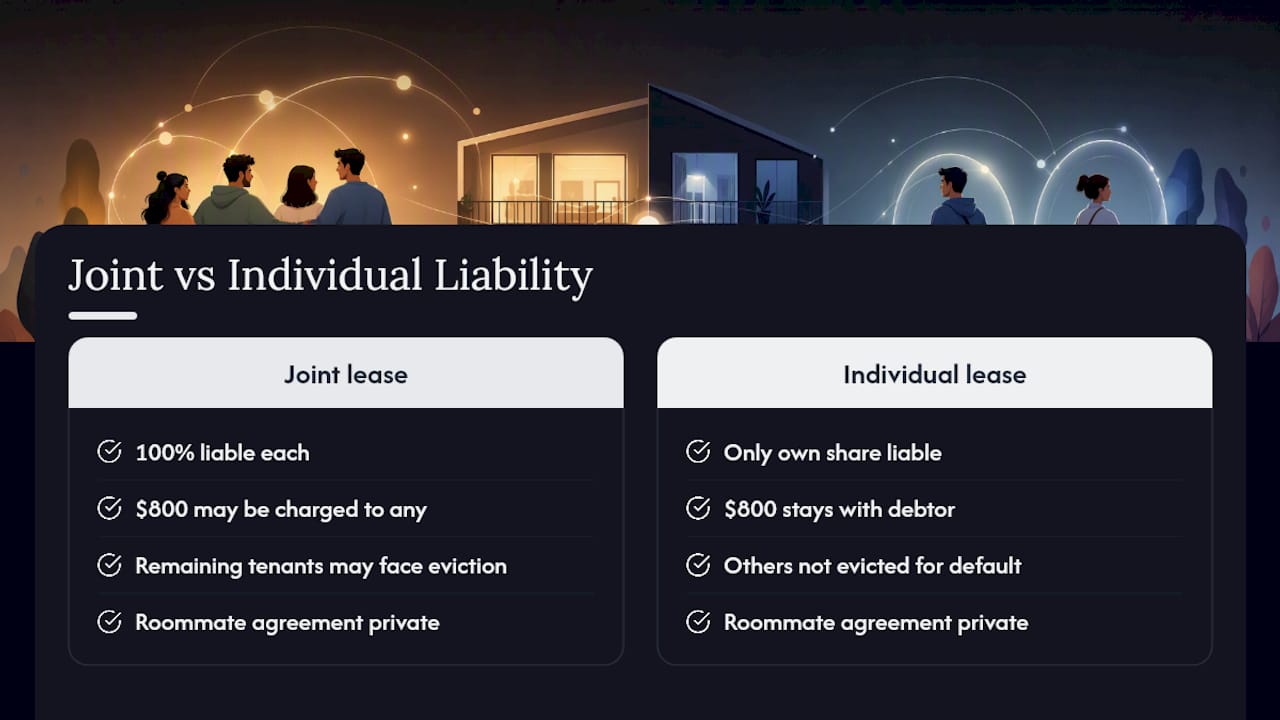
Contrast that with an individual lease, where each tenant signs a separate contract. If one person defaults, that debt legally stays with them. The other tenants aren’t obligated to cover it, even though they share the same address.
Here’s the scenario that trips people up: three friends sign a joint lease, one moves out mid-year without notice, and the landlord can still pursue eviction against the remaining two if the full rent isn’t paid, even though they didn’t cause the shortfall.
A roommate agreement won’t change any of this. It’s a private contract between tenants that can spell out who owes what internally, but it carries no weight with the landlord. If things go sideways, your local tenant board and official notice forms are the actual escalation path, not the roommate agreement sitting in a drawer.
Pro Tip: Keep a written log of who paid what and when, even with close friends. If a dispute ever lands in small-claims court, timestamped records beat memory every time.
How Much More Does an Individual Lease Cost?
Individual leases almost always carry a premium per bedroom. Landlords charge more because they absorb the administrative burden and vacancy risk themselves, filling empty rooms without waiting for tenants to find a replacement.
Picture a three-bedroom unit renting jointly for $2,400 total, or $800 per person. Split that same unit into individual leases, and each room might run $900 to $950 to offset the landlord’s added risk and paperwork. Deposits follow the same logic: joint leases often pool one deposit that gets divided (and disputed) at move-out, while individual leases keep deposits separate so one roommate’s damage doesn’t touch another’s refund.
Moving Out or Ending the Lease: What Changes by Lease Type
Ending a joint lease usually requires everyone to sign the notice together, since all tenants share equal responsibility for that single contract. One person can’t unilaterally end it for the group. An individual lease works the opposite way: each tenant can give notice and leave on their own timeline without needing sign-off from roommates.
If you’re facing a roommate who’s defaulting or leaving early, take these steps in order:
- Notify your landlord in writing as soon as you know about the change.
- Ask about assignment or subletting options.
- Document every conversation and payment, since this becomes evidence if a dispute escalates.
- Consider small-claims court to recover a roommate’s unpaid share if a private agreement falls apart.
Assignment and subletting exist for a reason. On a joint lease, transferring your spot to someone new usually needs landlord approval. On an individual lease, you’re often just ending your own contract, and the landlord fills the vacancy independently.
How to Choose the Right Lease Type for Your Situation
Before you sign anything, run through this checklist:
- How well do you actually know your roommates, and how long have you lived with them?
- How long do you realistically expect to stay in this unit?
- Can your budget absorb a roommate’s missed rent for a month while things get sorted?
- Do you want control over who replaces a departing roommate, or are you fine leaving that to the landlord?
- Is a cosigner involved, and does that change who’s exposed if rent goes unpaid?
Ask your landlord directly: Will they handle vacancies, or does that fall on the remaining tenants? Are leases structured by bedroom? Does the lease explicitly include joint-and-several language?
Watch for red flags in the lease itself: vague joint liability clauses, no mention of assignment or subletting rights, and unclear deposit-return terms are the three most common traps.
Pro Tip: If a lease doesn’t specify how deposits get divided among roommates, ask the landlord to add that clause before you sign. Verbal promises about deposit splits rarely survive a messy move-out.
Why Roommate Compatibility Matters More Than the Lease Type
The legal structure of your lease only manages risk after something’s already gone wrong. The better lever is reducing the odds a roommate stops paying or bails early in the first place. Mismatches in cleanliness habits, guest policies, or noise tolerance are the quiet drivers behind most roommate breakups, and roommate breakups are what turn a joint lease into a financial headache.
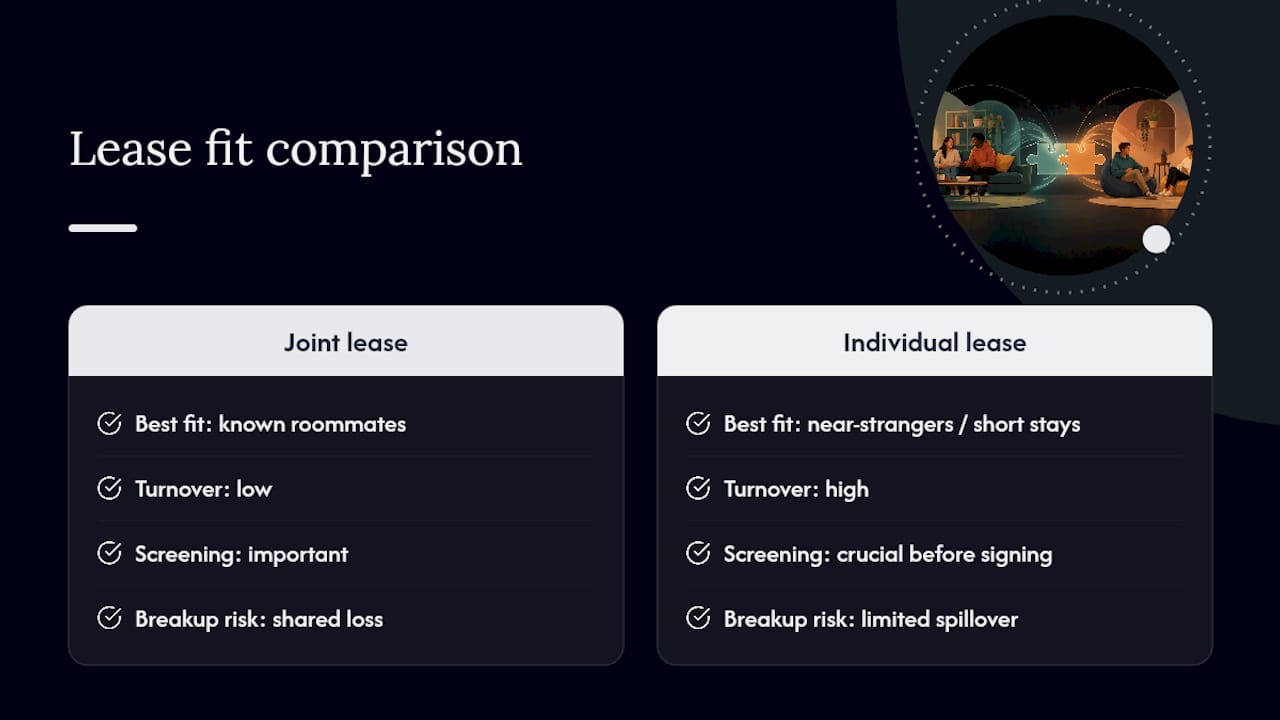
A joint lease makes the most sense with a tight-knit group who already knows each other’s habits and finances. Individual leases earn their premium when you’re housing with near-strangers or expect shorter, higher-turnover stays. Screening for lifestyle fit before you sign, not after you’ve moved in, is the difference between a lease type that protects you on paper and one that actually keeps the peace day to day.
— Salem
A Simpler Way to Lower Your Roommate Risk
A simpler way to shrink the risks that make individual leases feel necessary in the first place is to match with roommates based on cleanliness habits, noise tolerance, schedules, and guest policies before you ever sign anything.

Better fit upfront tends to mean fewer late payments, less turnover, and fewer of the disputes that turn a joint lease into a legal headache. It doesn’t change your lease terms or replace legal advice. Think of it as reducing the odds you’ll ever need to invoke joint-and-several liability against a roommate in the first place. If you’re weighing lease types right now, it’s worth checking compatible roommate matches before deciding how much financial exposure you’re comfortable signing up for.
Where to Go for Official Lease Guidance
For definitions and lease-type comparisons, see Off-Campus Housing (UNT) and LegalClarity. For notice requirements and official forms, check Queen’s Off-Campus Living Advisor. Always confirm rules with your local tenant board or university housing office, since requirements vary by region.
Sources
- What is the difference between an individual liability lease (by-the-bed) and a unit lease? | Off-Campus Housing (UNT)
- What Is an Individual Lease and How Does It Work? - LegalClarity
- Understanding Joint and Several Leases vs. Individual Leases in Ontario | Off-Campus Living Advisor
- Landlord and tenant rights (University of Colorado Denver guidance)
FAQ
Can One Person Break a Two-Person Joint Lease?
Not unilaterally. On a joint lease, ending the tenancy usually requires all signers to agree and provide notice together, so one roommate leaving doesn’t automatically release the other from the contract.
Can My Partner Live With Me if They’re Not on the Lease?
It depends on your lease terms. Most leases require unauthorized occupants to be added formally, since an unlisted partner living there isn’t covered by joint-and-several liability or renter protections tied to the lease.
Should Both Partners Be on a Joint Lease?
Yes, if both plan to live there long-term. Being off the lease means no legal claim to the unit and no protection under the lease’s terms, which creates risk for the unlisted partner.
What Happens if My Roommate Stops Paying Rent on a Joint Lease?
The landlord can demand the full rent from any remaining signer under joint-and-several liability, regardless of who actually missed the payment. On an individual lease, only the non-paying tenant is held responsible.
How Do I Know if My Lease Is Joint or Individual?
Check whether the contract lists one shared rent amount for everyone or separate amounts tied to individual rooms. If you’re unsure, ask your landlord directly whether joint-and-several liability applies before you sign.
Find a roommate you'll actually get along with
Roomit is preparing compatibility-first matching city by city. Join your local waitlist.