 Roomit
Renters & Landlords: Screen Roommates for Compatibility in 5–10 Minutes
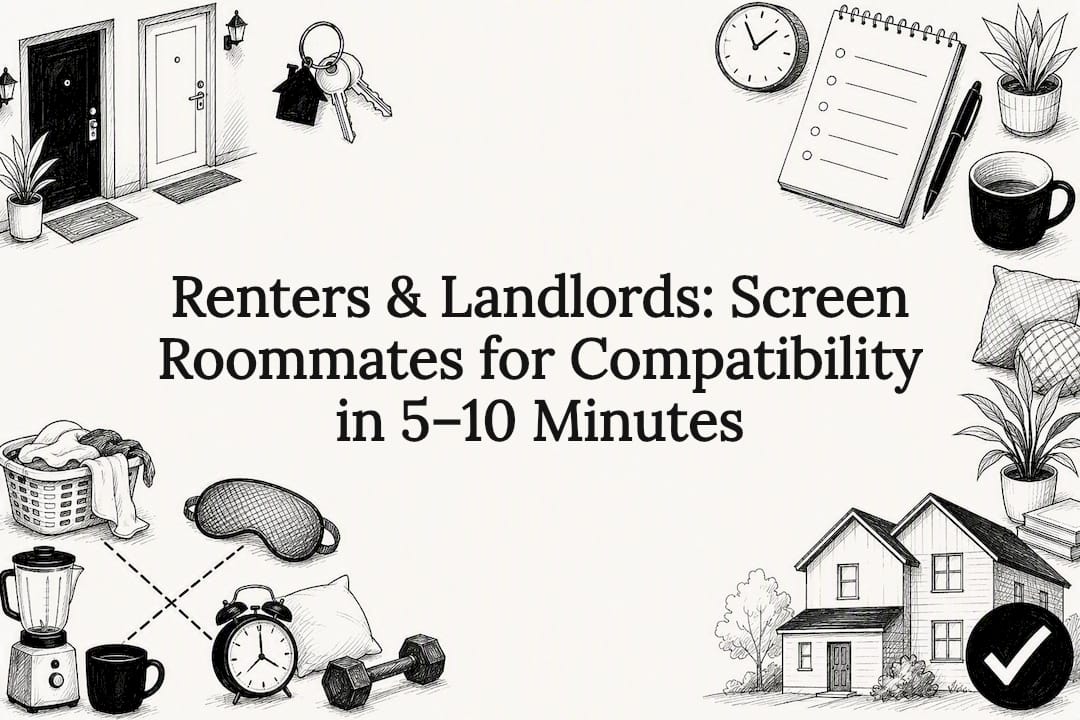
Roommate screening, done right, is a two-step process: a quick logistics filter followed by a structured compatibility interview, finished with a short written agreement. That sequence catches mismatches on move-in date, budget, and location before either of you wastes an hour talking, then digs into the lifestyle details, like cleanliness and noise, that actually break households. Some platforms build this exact workflow into their matching process.
TL;DR:
- Accurate screening emphasizes lifestyle compatibility over financial or background checks, focusing on routines, noise, cleanliness, and social habits.
- A quick logistics filter should be completed within ten minutes to confirm move-in date, budget, lease length, and deal-breakers like pets or smoking.
- The structured interview should explore daily routines, guest expectations, shared responsibilities, and personal space preferences through specific, open-ended questions.
- A written agreement outlining rent, utilities, chores, and guest policies minimizes disputes, with clear procedures for amendments and conflict resolution.
- Using screening platforms that match based on lifestyle details reduces mismatched inquiries and builds more stable, long-term shared living arrangements.
Table of Contents
- What Is Compatibility-Based Roommate Screening?
- How Do You Run a Compatibility Interview?
- What Belongs in a Written House Rules Agreement?
- Which Red Flags Actually Matter?
- How Do You Keep Communication Smooth After Move-In?
- Building Your Shortlist and Making the Final Call
- Setting Expectations and House Rules Before You Move In
- Looking Beyond the Basics: Hobbies and Social Habits
- Talking About Privacy and Personal Space
- What Past Roommate Experiences Reveal
- Handling Pets and Allergies Honestly
- Should You Try a Trial Period First?
- Why Compatibility Screening Actually Prevents Turnover
- How Roomit Simplifies Compatibility Screening
- Where to Find More Screening Questions and Templates
- Sources
- FAQ
What Is Compatibility-Based Roommate Screening?
Compatibility-based roommate screening means evaluating how someone actually lives, not whether they’d pass a background check. You’re looking at sleep schedules, noise tolerance, guest habits, and how they split a grocery bill, not credit scores or eviction records. That distinction matters because two people with perfect financial histories can still make each other miserable if one works night shifts and the other hosts board game nights every Tuesday.
The quick filter comes first because it’s cheap. A five to ten minute exchange, over text or a short call, confirms the basics before anyone invests real time. Here’s what to nail down immediately:
- Move-in date: does it match your timeline within a week or two?
- Max rent: is their stated budget your actual asking price, not a number they’re hoping to negotiate down?
- Lease length: are they looking for a year or a few months, and does that match your lease?
- Commute tolerance: have they actually looked at the transit or driving time from this address?
- Pets and smoking: hard deal-breakers get stated up front, not discovered during a walkthrough.
- Basic furniture needs: do they need a furnished room, and can you provide one?
A simple message template works better than a long questionnaire here. Try something like: “Thanks for reaching out. Quick check before we set up a call: what’s your target move-in date, your max monthly budget, and do you have pets or smoke?” Direct questions get direct answers, and vague or evasive replies at this stage are worth noticing early.
Pro Tip: Book a ten-minute video call before the full interview. Practitioners who screen roommates regularly recommend this as a fast way to rule out obvious mismatches, like someone who “works from home” but means a coffee shop three days a week, before you commit to a longer conversation.
How Do You Run a Compatibility Interview?
Once logistics check out, the real work starts. A structured 30 to 60 minute conversation, in person or by video, should move through specific categories rather than a generic “tell me about yourself.” Open-ended questions that request concrete examples work far better than self-descriptions, according to The Visual Communication Guy’s guidance on roommate interviews, because almost everyone describes themselves as “clean” and “easygoing.” The gap shows up in the details.
Cover these categories in order:
- Routine and sleep schedule: What time do you usually wake up and go to bed on a workday? What about weekends?
- Cleanliness habits: How often do you clean the bathroom, and who usually initiates it in your current place?
- Noise and quiet hours: Do you play music or take calls out loud, and is there a time you need quiet?
- Guests and overnights: How often do you have people over, and how much notice do you usually give?
- Food and shared supplies: Do you cook often, and are you comfortable sharing basics like paper towels or dish soap?
- Work-from-home needs: Do you work remotely, and do you need quiet during specific hours?
A structured question set covering cleaning frequency, guest expectations, and past conflict handling consistently surfaces the friction points that matter most before move-in. Notice the phrasing: “How often do you clean the bathroom?” gets a real answer. “Are you clean?” gets a reflexive “yes” from almost anyone.
Watch tone as much as content. Someone who asks you questions back, who negotiates rather than just agreeing to everything, is showing you they’ll actually communicate once you’re living together. Reciprocal questioning is a good sign, and its absence is worth noting. Red flags include one-word answers to specific questions, defensiveness about past living situations, or a refusal to give any concrete example when you ask for one.
What Belongs in a Written House Rules Agreement?
A one-page written agreement, signed before move-in, prevents most disputes because it gives you something to point back to when memory gets fuzzy. Written agreements that document rent, utilities, chores, and guest rules genuinely reduce conflict compared to verbal understandings, mostly because verbal agreements drift over time and nobody remembers the original terms the same way.
Your agreement should cover:
- Rent split: exact dollar amounts and whether it’s equal or adjusted for room size
- Utilities: which bills are split, in what proportion, and who’s the account holder
- Payment schedule: due date, method (bank transfer, check, app), and what happens if someone pays late
- Deposit and damage policy: how the security deposit gets split and returned, and who pays for what damage
- Chore system: rotating or assigned, and how often it’s reviewed
- Guest policy: how many nights per week guests can stay before it’s a conversation
- Quiet hours: specific times, especially on weeknights
Two simple templates make this easier to execute. A payment schedule just needs columns for due date, amount, payer, and payment method, with a row for each month. A chore rota needs a list of recurring tasks (kitchen, bathroom, common areas, trash) with a rotating assignment by week or month.
Build in a process for changes too. Require written notice, even just a text, at least two weeks before any amendment takes effect, so nobody feels blindsided by a new rule sprung on them mid-month.
Which Red Flags Actually Matter?
Compatibility screening isn’t a background check, and it shouldn’t try to be. You’re not pulling credit reports or criminal records here. You’re watching behavior during the screening process itself, because how someone handles this conversation often predicts how they’ll handle living together.
Watch for these patterns:
- Evasiveness about income or budget when you ask directly
- Stories about their current living situation that don’t quite add up or contradict earlier answers
- Refusal to do a video call, especially after multiple requests
- Inability to give one specific example when you ask about a past roommate conflict
Verification here means confirming logistics, not digging into someone’s history. Ask for a reference from a previous roommate or landlord, someone who can speak to how they actually lived day to day. Confirm move-in intent with a modest holding deposit once you’ve agreed verbally. Double-check availability against a shared calendar rather than taking someone’s word for a flexible move-in date.
Many Americans have lived with a roommate at some point, which means most people you screen have a comparison point for what “normal” looks like. That history is exactly what your interview questions should surface.
How Do You Keep Communication Smooth After Move-In?
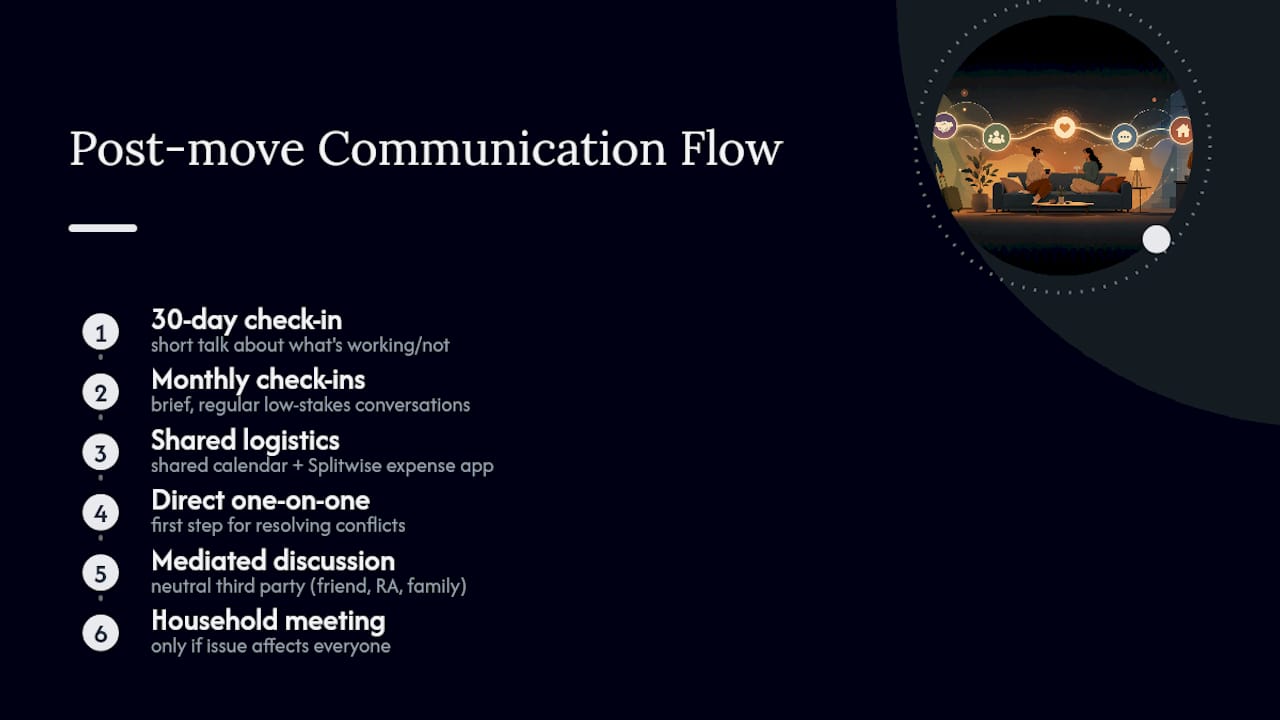
Screening well doesn’t end the work. Set a 30-day check-in on the calendar before you even move in, a short conversation about what’s working and what’s not, then shift to brief monthly check-ins after that. Regular, low-stakes conversations catch small irritations before they calcify into resentment.
A shared calendar and a simple expense-tracking app (Splitwise is the common choice) handle the logistics so nobody’s keeping mental tabs on who bought toilet paper last. For actual conflict, follow an escalation path: a direct one-on-one conversation first, then a mediated chat with a neutral third party (a mutual friend, a resident advisor, or a family member) if the direct talk doesn’t resolve it, and a full household meeting only if the issue affects everyone. Noise and shared-living research points to unresolved small frictions as a common driver of bigger roommate breakdowns.
Pro Tip: Frame requests neutrally. “Can we talk about trash timing?” lands better than “You never take out the trash,” because the first invites a conversation and the second invites defensiveness.
Building Your Shortlist and Making the Final Call
By the time you’ve run the quick filter and the compatibility interview with two or three candidates, you should have enough information to compare them side by side rather than picking based on gut feeling alone.
Score each candidate against the categories that matter most to you. A simple table works well here:
| Category | Weight | Candidate notes |
|---|---|---|
| Logistics fit (move-in date, budget) | Must-have | Pass/fail |
| Cleanliness alignment | High | Specific examples given? |
| Noise/schedule compatibility | High | Overlap or conflict? |
| Guest policy alignment | Medium | Compatible expectations? |
| Communication style | Medium | Reciprocal, specific answers? |
Treat logistics as pass/fail. If someone can’t meet your move-in date or budget, no amount of lifestyle compatibility fixes that, so don’t let a great personality talk you into a bad fit on the fundamentals.
For everything else, look for alignment rather than identical answers. You don’t need a roommate who shares your exact schedule, you need one whose schedule doesn’t actively conflict with yours. A night-shift worker and an early riser can coexist fine if both are honest about it upfront and neither expects the other to change.
Give yourself a short cooling-off period, even just overnight, before committing to a final decision. First impressions during an interview run warmer than day-to-day reality, and a night’s distance tends to surface any lingering doubts you talked yourself out of during the conversation.
Setting Expectations and House Rules Before You Move In
The single biggest predictor of roommate conflict isn’t incompatibility. It’s unspoken assumptions that never got said out loud. Two people can be genuinely compatible and still end up frustrated because neither one stated what they expected.
Before move-in day, sit down together and talk through scenarios you haven’t already covered in the interview: What happens if rent is late one month? Who’s responsible for restocking shared cleaning supplies? Is it okay to eat each other’s food if you ask first, or is the fridge strictly separate? These smaller questions rarely come up naturally, but they cause outsized friction when they’re never addressed.
Write down anything you agree on, even informally, in a shared document or text thread you can both refer back to. This doesn’t need to be a formal contract beyond the one-page agreement you’ve already drafted. It just needs to exist somewhere other than memory.
Revisit these expectations after the first two weeks of actually living together. Plans made in the abstract during an interview often need small adjustments once real life intervenes, and that’s normal, not a sign the match failed. The households that struggle are the ones that never circle back to check whether the original agreement still fits.
Looking Beyond the Basics: Hobbies and Social Habits
Cleanliness and noise cover the fundamentals, but day-to-day compatibility often comes down to smaller lifestyle details that rarely make it onto a standard checklist. Someone who practices a musical instrument, someone who trains for early morning runs, someone who’s building a home gym in the living room, these habits shape shared space just as much as chore schedules do.
Ask about how they spend a typical evening or weekend. Do they work out at home or at a gym? Do they have a hobby that involves equipment, noise, or a lot of space? Are they naturally social, hosting friends often, or do they keep to themselves most nights? Neither answer is wrong, but mismatches here create the low-grade friction that doesn’t show up in a logistics filter.
Social energy matters more than most people expect going in. An introvert who wants a quiet home base and an extrovert who treats the apartment as a social hub can absolutely coexist, but only if both people know that going in and agree on how to balance it. Ask directly: “How often do you like having people over, and would that change if I asked you to keep it to certain nights?” The answer tells you whether they’ll adapt to shared space or expect the space to adapt to them.
Talking About Privacy and Personal Space
Privacy expectations vary more than people assume, and they rarely come up unless you ask directly. Some people are comfortable with roommates wandering into their room to grab a phone charger. Others consider a closed bedroom door an absolute boundary, no exceptions.
Ask specific questions: Are you comfortable with me knocking versus just walking in if your door’s open? How do you feel about borrowing shared items like chargers, kitchen tools, or clothes without asking every time? Do you need a signal for “I need quiet time” versus “I’m available to talk”?

Bathroom scheduling deserves its own conversation, especially in a two-bedroom, one-bath setup where morning routines can collide. So does personal space in common areas. Someone who works from the couch all day has a different relationship with the living room than someone who’s only home in the evenings, and that difference is worth naming before it turns into quiet resentment about “their side” of a shared space.
None of this needs to feel like an interrogation. Frame it as mutual: “I like some quiet time after work before I’m really social, does that work for you?” invites an honest answer instead of a performance of agreeableness.
What Past Roommate Experiences Reveal
How someone talks about a former roommate tells you more than almost any other question in the interview. Ask directly: “What was the biggest source of friction with your last roommate, and how did you two handle it?”
Listen for accountability. Someone who can describe their own role in a past conflict, even a small one, is showing self-awareness. Someone who describes every past roommate as impossible, unreasonable, or crazy, with zero acknowledgment of their own part in any friction, is a pattern worth taking seriously. Everyone has had at least one roommate mismatch; how they narrate it matters more than the mismatch itself.
Where possible, ask for a reference. A quick text or call to a previous roommate or landlord, asking simply “How was living with them day to day?”, gives you outside perspective that self-reporting can’t. Most people are honest in these conversations because they have little reason to lie about someone they no longer live with.
If a candidate resists providing any reference at all, or claims they’ve “never lived with anyone before” despite being well into their twenties or thirties, treat that as a gap worth a follow-up question rather than an automatic disqualifier. Sometimes it’s true. Often it’s worth a gentle second question to understand why.
Handling Pets and Allergies Honestly
Pets create some of the most common, and most avoidable, roommate conflicts, largely because people underestimate how much a pet changes daily life for everyone in the household, not just the owner.
Ask specifically: Do you have a pet now, or plan to get one? What kind, and how is it trained around guests and shared spaces? If you don’t have a pet, do you have allergies, and how severe are they? Even “mild” allergies can become a real problem in a small shared space over months of exposure, so get specifics rather than accepting a vague “I’m fine with pets.”
If one of you has a pet and the other has allergies, don’t assume this resolves itself with a little distance. Talk through realistic scenarios: shared furniture access, bedroom doors staying closed, cleaning frequency for pet hair. These conversations feel awkward before move-in and much worse after, when a lease is already signed and feelings are already involved.
Landlord and lease restrictions matter here too. Confirm the actual pet policy on the unit itself before any conversation about a roommate’s pet goes further, since a compatible roommate arrangement means nothing if the lease doesn’t allow the animal at all.
Should You Try a Trial Period First?
A short trial arrangement, whether that’s a month-to-month sublet, a few weeks of overlap before a full lease commitment, or simply an agreement that either party can exit with 30 days’ notice in the first two months, takes real pressure off the decision.
Trial periods work best when both sides agree on them explicitly rather than one person quietly treating the arrangement as temporary while the other assumes it’s permanent. Set a specific check-in date, 30 or 60 days out, where you both honestly assess how things are going. Put it on the calendar during the initial agreement conversation, not as an afterthought once tension has already built.
This approach suits situations with real uncertainty, like a roommate found quickly during a housing crunch, a compatibility interview that went well but left a few open questions, or a first-time roommate situation for either party. It’s less necessary when logistics, interview answers, and references all point the same direction.
Why Compatibility Screening Actually Prevents Turnover
Most roommate turnover doesn’t come from one dramatic blowup. It comes from an accumulation of small mismatches nobody screened for: different sleep schedules, different guest expectations, different definitions of “clean.” A structured process that surfaces these details before move-in catches what a credit check never will.
The pattern holds across most shared-living situations: households that document expectations early report fewer conflicts later.
If this article leaves you with one habit to keep, it’s this: write things down, and revisit them. Compatibility isn’t a one-time assessment; it’s an ongoing conversation you’re setting up the structure for.
— Salem
How Roomit Simplifies Compatibility Screening
Running a quick filter, a full interview, and a written agreement manually works, but it takes real time across multiple candidates. Some platforms are built around a compatibility-first workflow, matching people based on cleanliness habits, noise tolerance, guest policies, work schedules, and budget before you ever get to a conversation.

Instead of screening every inquiry from scratch, Some platforms surface candidates whose lifestyle answers already align, then give you structured interview prompts to confirm the fit in your own conversation. Templated agreements cover common issues like rent split, chore system, and guest policy details, so you’re not building a document from a blank page. Listings can emphasize lifestyle fit over just square footage and price, potentially reducing mismatched inquiries.
If you’re currently screening roommates one message at a time, visit Roomit to see how compatibility matching narrows your search before the first interview even happens.
Where to Find More Screening Questions and Templates
For a longer bank of interview questions covering cleaning, guests, and daily routines, Zillow’s list of 35 roommate questions offers additional prompts to pull from. For a full checklist covering safe screening steps and a written agreement structure, DirectProLogistics’ roommate guide walks through the logistics side in detail.
Sources
- Roommate Interviews: Communication Tips For Asking the Right Questions - The Visual Communication Guy
- How to Find a Roommate: Safe Screening, Questions to Ask, and a Roommate Agreement Checklist
- How to Find a Roommate: 10 Questions to Ask Your Roommate - Moving Help®
FAQ
What Is the First Step in Roommate Screening?
Start with a five to ten minute quick filter, by text, message, or a short call, confirming move-in date, budget, lease length, and any pet or smoking deal-breakers before scheduling a longer interview.
How Long Should a Compatibility Interview Take?
Plan for 30 to 60 minutes covering routine, cleanliness, noise, guests, and work-from-home needs, ideally over video so you can also read tone and reciprocity.
Does Roommate Screening Include a Background Check?
Compatibility-based roommate screening focuses on lifestyle alignment, cleanliness, noise, guests, and schedule, rather than credit, criminal, or eviction checks, which are a separate process entirely.
What Should Be in a Roommate Agreement?
A one-page agreement should cover rent split, utility responsibilities, payment schedule, deposit and damage policy, chore system, guest rules, and quiet hours, signed by both parties before move-in.
How Does Roomit Help With Roommate Screening?
Roomit matches people based on cleanliness, noise tolerance, guest policies, schedule, and budget, then provides interview prompts and templated agreements to support the screening process from first contact through move-in.
Find a roommate you'll actually get along with
Roomit is preparing compatibility-first matching city by city. Join your local waitlist.