 Roomit
Digital Nomad Coliving: 4 Types With Backup Internet
Digital nomad coliving bundles a private room, a work-ready workspace, and a built-in community into one booking, so you skip the usual scramble to piece together housing, Wi-Fi, and a social life in a new city. The best setups deliver reliable internet, ergonomic desks, and structured programming that turns strangers into a support network within days. It’s the right call for remote workers who run video calls daily, freelancers craving accountability, and founders who want a productive base without a long-term lease.
TL;DR:
- Reliable internet with a backup connection is essential, especially for video calls, and hosts who confirm secondary ISP or Starlink availability reduce connection risk.
- Programmed community activities and a vetted, diverse cohort improve long-term social bonds and reduce the chances of quick resident turnover or mismatched expectations.
- Matching the coliving format to your travel rhythm, such as static houses or edition-based programs, prevents frustration caused by unsuitable stay lengths or group dynamics.
- Location-based regulations and licensing impact the legality and safety of a house, so confirming proper permits and understanding local rules help avoid unexpected shutdowns or legal issues.
- Considering sustainability practices like energy efficiency, shared resources, and community meals can inform eco-conscious choices without necessarily being a deal-breaker.
Table of Contents
- What Is Digital Nomad Coliving, and How Is It Different?
- What Types of Coliving Should You Know About?
- Which Amenities Actually Matter for Remote Work?
- How Do You Spot a Real Coliving Community?
- How Do You Choose the Right Coliving for You?
- What Do Coliving Stays Typically Cost?
- How Do You Prepare for a Coliving Stay?
- What Legal and Visa Rules Apply to Coliving Stays?
- What Health and Safety Protocols Should a Coliving House Have?
- How Do You Adapt to a New Coliving Community?
- How Do Local Laws Shape Coliving Arrangements?
- What Sustainable Practices Show Up in Coliving Spaces?
- Why Roommate Compatibility Matters More Than Most Coliving Guides Admit
- Ready to Find Your Compatible Coliving Match?
- Sources
- FAQ
What Is Digital Nomad Coliving, and How Is It Different?
Coliving combines private rooms with shared common areas, programming, and coworking-style workspaces built specifically to support long-term remote work and community living, according to WorldPackers. That’s the core distinction from a hostel, an Airbnb, or a coworking membership bought separately: coliving stitches all three together under one host and one price.

A hostel gets you a bed and maybe a common room, but rarely a desk that survives an eight-hour workday. A short-term rental gives you privacy and nothing else. It’s just you, a router of unknown quality, and zero built-in social structure. A coworking membership solves the desk problem but leaves you to find housing on your own, often in a neighborhood you don’t know yet.
Coliving removes that friction by design. You show up, and the workspace, the Wi-Fi, and a cohort of people doing similar work are already there.
Here’s when coliving beats the alternatives:
- You’re staying somewhere for two weeks to several months and don’t want to negotiate a lease.
- You need consistent, professional-grade internet for calls, not “usually fine” residential Wi-Fi.
- You’re traveling solo and want a built-in social circle without joining every meetup in town.
- You value structure. Regular meals, scheduled work sessions, and events beat figuring it all out alone.
- You’re relocating between cities and want the onboarding (workspace, community, local tips) to be instant, not a two-week ramp-up.
If none of that applies, and you just need a quiet place to sleep for three nights, coliving is overkill. It’s built for people who live and work somewhere, not people passing through.
What Types of Coliving Should You Know About?
Coliving isn’t one product. The format changes the experience more than the marketing photos suggest, and picking the wrong type is the most common regret nomads report.
- Static houses. These are permanent locations with rolling arrivals and departures, longer minimum stays, and deep local roots. Staff know the neighborhood, the best cafés, and the visa office’s actual hours. Static houses suit nomads who want to settle into one place for a month or more and build real local ties.
- Nomadic or edition-based programs. These run on fixed dates with a fixed cohort that moves as a group, sometimes across multiple countries in a single program. WiFi Tribe runs this model, pairing a coliving-plus-coworking setup with a group that stays together for weeks at a time. You trade some flexibility for a ready-made social calendar and less onboarding friction.
- Retreat-style stays. Short, intensive experiences, often a week or two, built around a theme: a writing sprint, a fitness reset, a specific skill. These work well for a focused push rather than ongoing remote work.
- Niche houses. Family-friendly colivings, sober living spaces, and entrepreneur-focused houses cater to a specific slice of the nomad population. If you’re traveling with kids or specifically want a house full of founders, the niche matters more than the amenities list.
Matching the format to your actual travel rhythm, not just your budget, is what separates a great coliving stay from a frustrating one.
Which Amenities Actually Matter for Remote Work?
Internet quality is the single biggest predictor of whether a coliving stay works for your job, and it’s also the amenity marketing photos hide best. Standard residential Wi-Fi frequently can’t handle back-to-back video calls with multiple people streaming simultaneously, which is why serious coliving operators build in redundancy rather than hoping one connection holds up, per NomadUnion.
Here’s what to check before you book, in order of importance:
- Redundant internet. Ask specifically whether there’s a backup connection, like a secondary ISP or a Starlink unit, that kicks in automatically if the primary line drops.
- Dedicated coworking zones. A separate room or floor for work, not a kitchen table shared with breakfast dishes.
- Ergonomic furniture. Real desks and chairs, not a beanbag and a coffee table.
- Meeting rooms or call booths. Somewhere to take a client call without narrating your day to the whole common room.
- Reliable power and climate control. Outages and heat waves kill productivity fast, especially in regions with unpredictable grids.
- Laundry and basic upkeep. Small, but it adds up over a month-long stay.
Pro Tip: Ask the host this exact question before you book: “What happens to my Wi-Fi if the main connection goes down mid call?” Their answer tells you more about the setup than any photo on the listing.
Failover connectivity is a detail most listings never mention, yet it’s the one that determines whether your Tuesday afternoon call actually happens. Hosts who invest in a secondary ISP or a Starlink backup are signaling they understand what remote work actually requires, not just what looks good in a listing photo.
How Do You Spot a Real Coliving Community?
Programming is what separates a coliving house from a building full of strangers who happen to share a kitchen. Curated programs with small, vetted cohorts and structured events like skill-shares and accountability sessions report stronger social outcomes and longer-lasting networks after the stay ends than open sign-up houses, according to Savi Coliving.
That vetting matters more than it sounds. An open sign-up house takes anyone with a credit card, which means your cohort is a coin flip. A curated program screens applicants first, often through a short application, which keeps the group more aligned on work habits, social energy, and lifestyle expectations. Savi Coliving in Valencia, for instance, requires an application specifically to reduce mismatch and support tighter group dynamics.
Look for these signs of a genuinely strong community before you commit:
- A published weekly schedule with recurring events (dinners, skill-shares, local excursions), not a vague promise of “community vibes.”
- Clear communication from the host about house norms and who to contact for issues.
- Evidence of returning guests or extended stays. People who leave quickly are a signal worth noticing.
- A visible mix of professions and stay lengths, which usually means richer conversations than a house full of people on identical two-week trips.
Red flags run the other direction: events that get canceled without notice, high resident turnover within a single month, or a host who’s vague about who actually handles day-to-day issues. If you can’t get a straight answer about who’s in charge when something breaks, that’s your answer about how the stay will go.
How Do You Choose the Right Coliving for You?
Comparing three or four coliving houses side by side gets messy fast unless you’re scoring the same criteria every time. Build a simple checklist, apply it to every contender, and let the numbers do the deciding instead of the prettiest photos.
Screening checklist, ranked by what breaks a stay fastest:
- Internet redundancy: is there a real backup connection, and has the host confirmed it works?
- Workspace specs: desk height, chair quality, natural light, and whether the space is separate from sleeping areas.
- Cohort size and selection: how many residents, and is there any vetting or application process?
- Minimum stay requirement: does it match your actual travel plans, or will you pay for time you don’t need?
- Cost transparency: does the quoted rate include coworking, meals, and events, or are those extra?
Exact questions to ask a host before you book:
- “What’s your backup plan if the main internet connection fails?”
- “Are there quiet hours or noise restrictions, and when do they apply?”
- “Is there a bookable meeting room for client calls, and does it cost extra?”
- “What’s your cancellation policy, and is any part of the deposit refundable?”
- “How many people are currently staying, and is there a cap on group size?”
Score each contender from 1 to 5 across those five checklist items, then add the totals. A house that scores a 4 on internet and workspace but a 2 on community transparency is telling you exactly where the risk sits. Discovery tools like Coliving Compass can help you filter by location, budget, and amenities before you even start reaching out to hosts, which narrows your shortlist before the scoring even starts.
What Do Coliving Stays Typically Cost?
Pricing models vary more than most first-time nomads expect, and the sticker price rarely tells the whole story. Some houses charge nightly, others weekly or monthly, and the gap between an all-inclusive rate and one loaded with add-ons can be significant once you tally coworking access, meals, and cleaning fees separately.
Many coliving operators present pricing as a single all-inclusive rate that folds in coworking access and programming, sometimes converting it into an effective nightly figure even for guests booking by the month, as seen with houses like Santa Marta Life Coliving. That structure makes budgeting simpler, but it also means you should ask exactly what’s bundled before comparing two listings that look similar on the surface.
What tends to move the price up or down:
- Location. A house in a major capital costs more than the same setup in a smaller regional city.
- Meal inclusion. Full board versus a shared kitchen with no groceries provided changes the math significantly.
- Coworking access. Some houses fold workspace access into the room rate; others charge it separately.
- Stay length. Monthly rates almost always beat the nightly rate stacked over 30 days.
Before booking, confirm the deposit amount and whether it’s refundable, read the cancellation window closely, and check whether the stay length affects any visa considerations for your destination. A month-long stay can sometimes tip you into different visa territory than a two-week one, depending on the country.
How Do You Prepare for a Coliving Stay?
Getting the logistics right before you land saves you from your first three days being spent hunting down an adapter instead of working.
- Pack the essentials. A universal power adapter, a compact travel monitor if you rely on dual screens, noise-cancelling headphones, and a power strip for rooms with limited outlets.
- Handle logistics before you leave. Travel insurance, a local SIM or eSIM, a clear check-in plan across time zones, and a backup power bank in case of outages.
- Do these things on arrival. Introduce yourself to the group, actually read the house rules instead of skimming them, and sign up for a chore or contribution slot early.
- Practice basic shared-living etiquette. Keep calls in designated zones, respect posted quiet hours, and clean up after yourself in shared kitchens without being asked twice.
Pro Tip: Message the house group chat or host before you arrive and ask what time zone the community mostly operates on. Showing up already synced to their rhythm makes the first 48 hours far smoother.
What Legal and Visa Rules Apply to Coliving Stays?
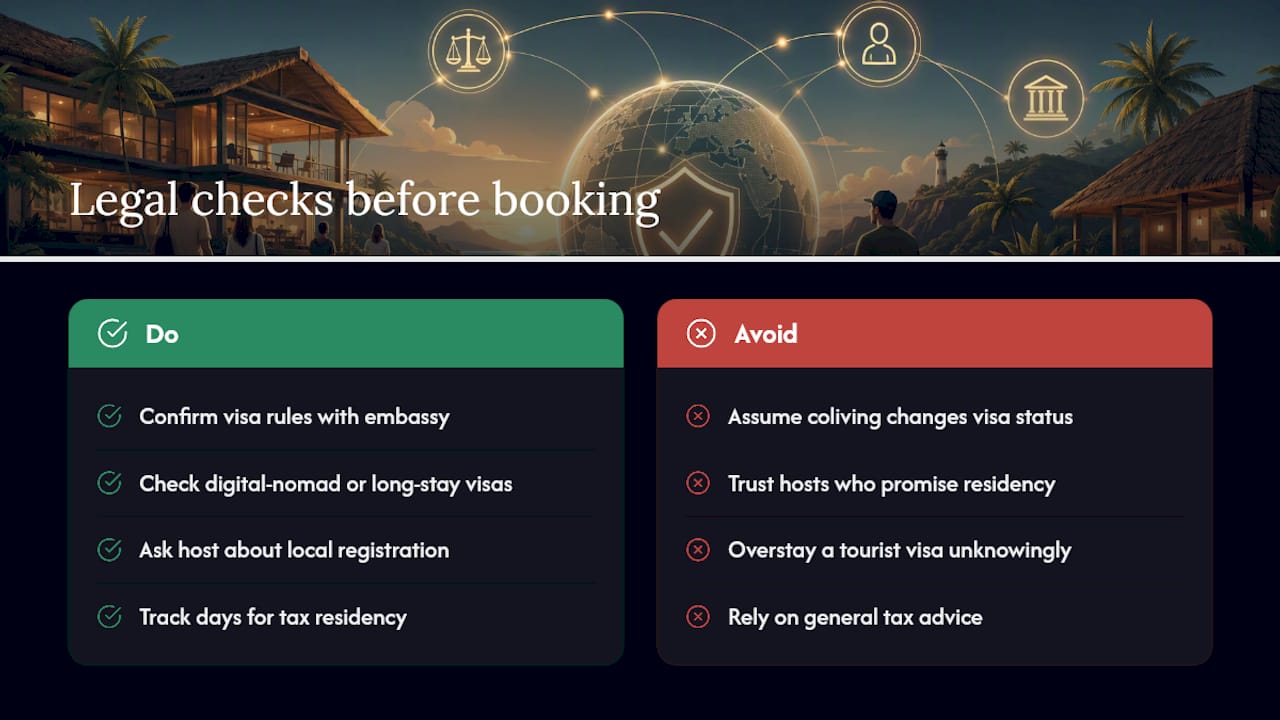
Coliving doesn’t create its own legal category. You’re still subject to whatever visa, tourist entry, or residency rules apply in the country you’re visiting, and the coliving house has no power to change that. A host who tells you otherwise is giving you bad information.
The most common issue nomads run into is overstaying a tourist visa because a coliving booking made the location feel permanent when the legal entry terms were still temporary. If your stay runs longer than a standard tourist window, look into whether the country offers a digital nomad visa, a long-stay visa, or requires a border run. Some countries now issue dedicated digital nomad visas specifically because demand from remote workers made the old tourist categories unworkable, but eligibility, income requirements, and duration vary widely by country and change often enough that you should verify directly with that country’s immigration authority before booking anything nonrefundable.
Registration requirements matter too. Some jurisdictions require short-term guests to register with local police or a housing authority within a set number of days of arrival. A well-run coliving house should know this and walk you through it. If a host seems unsure whether registration applies, ask directly rather than assuming it doesn’t.
Tax residency is the other trap. Spending enough cumulative days in one country, even across multiple coliving stays, can trigger tax residency obligations you didn’t plan for. This is genuinely complex and country-specific, so treat any general advice, including this, as a starting point, and confirm your specific situation with a tax professional familiar with cross-border remote work before committing to a long stay anywhere.
What Health and Safety Protocols Should a Coliving House Have?
A well-run coliving house should have basic safety infrastructure that’s easy to verify before you arrive: working smoke detectors, a clearly marked fire exit, a first aid kit somewhere accessible, and a host who can be reached quickly if something goes wrong. Ask about these directly if the listing doesn’t mention them. A host who can’t answer confidently is a signal worth taking seriously.
Shared living also means shared exposure. Kitchens used by a dozen or more people need real cleaning schedules, not an honor system that quietly fails after the first week. Bathrooms, especially shared ones, should have a documented cleaning rotation, and a house that leaves this entirely to residents’ goodwill tends to slide fast once a few people stop pulling their weight.
Illness spreads quickly in shared housing, so ask what the house’s policy is if someone gets sick, whether that means a cold or something requiring isolation. Some houses have a spare room set aside for this; others have no plan at all, which is worth knowing before you’re the one who gets sick two weeks into a monthly stay.
Emergency contact information matters more abroad than at home. Confirm the house has posted local emergency numbers, knows the nearest hospital or clinic, and has a clear protocol for medical emergencies, especially if the coliving is in a remote location where response times run longer than you’d expect. This is a reasonable question to ask directly and not one you should have to guess about after you’ve already checked in.
How Do You Adapt to a New Coliving Community?
Every coliving house has its own unwritten social rhythm, and figuring it out fast makes the difference between feeling like a guest and feeling like part of the group. The fastest way in is showing genuine curiosity about the people already there instead of waiting for someone to explain the house culture to you.
Start by observing before you assume. A house that eats dinner together every night at 7:00 PM has a different rhythm than one where everyone works odd hours and grabs food solo. Match the existing pattern for your first few days rather than immediately proposing changes, even well-meaning ones.
Language and cultural norms shift by location, and that extends to the coliving itself. What counts as friendly directness in one culture reads as rude in another, and a mixed-nationality house usually settles into its own hybrid norm within the first week or two. Pay attention to how residents from the host country interact with each other, not just with fellow travelers, since that often reveals the actual local etiquette rather than the tourist-facing version.
Contributing early builds trust faster than almost anything else. Volunteer for a task, share a skill during a group session, or simply help clean up without being asked. Small, consistent actions read as reliability, and reliability is what turns a temporary roommate into someone people actually remember after you’ve moved on.
How Do Local Laws Shape Coliving Arrangements?
Coliving houses operate inside local zoning, housing, and short-term rental regulations, and those rules vary enormously by city and country. Some municipalities classify coliving as a standard residential rental, others treat it closer to a hotel or guesthouse, and a growing number have introduced rules specifically targeting short-term shared housing after complaints from long-term residents about noise or overcrowding.
This matters to you as a guest because a house operating outside local regulations can be shut down mid-stay, leaving you scrambling for alternative housing with little notice. Ask a host directly whether the property is licensed for short-term shared occupancy if that information isn’t already listed. A host who dodges the question or gets vague is worth treating with caution.
Local caps on the number of unrelated occupants per property, fire safety codes for shared housing, and short-term rental permit requirements all affect whether a coliving house is running legitimately. These rules exist for real reasons, safety among them, and a house cutting corners on regulation is often cutting corners elsewhere too.
Regulation is also reshaping the coliving industry itself. Cities that have tightened short-term rental rules have pushed some coliving operators toward longer minimum stays specifically to fit residential rather than hospitality classifications, which is part of why minimum stay length varies so much between static houses. Understanding this context helps explain listings that otherwise seem inconsistent.
What Sustainable Practices Show Up in Coliving Spaces?
Shared housing has a natural sustainability advantage that solo living doesn’t: fewer appliances, shared utilities, and communal meals reduce per-person resource use almost automatically. The better coliving houses lean into that advantage rather than treating it as an accident.
Look for practical signals rather than marketing language. Solar panels or energy-efficient appliances reduce a house’s utility footprint directly. Composting systems and shared grocery buying cut food waste in ways that are hard to replicate living alone. Water-saving fixtures and clear recycling systems, especially in regions where waste sorting isn’t standard, show a house that’s put real thought into its operations rather than just its aesthetic.
Community meals deserve a specific mention here. A house that cooks shared dinners using local, seasonal ingredients is usually operating with a smaller footprint than one relying on individual takeout orders every night, and it tends to build community faster too.
None of this should be the deciding factor in choosing a coliving house over amenities and community fit, but it’s worth factoring into your decision if a house is transparent about these practices versus one that never mentions them at all. Ask directly if it matters to you. A host with real answers usually has real practices behind them.
Why Roommate Compatibility Matters More Than Most Coliving Guides Admit
Most coliving advice treats the workspace and the community programming as the whole story, and that misses the part that actually determines whether a stay feels good day to day: who you’re living next to. A house can have flawless internet redundancy and a packed events calendar and still feel wrong if your closest housemate keeps different hours, has an opposite tolerance for noise, or handles guests in a way that clashes with yours.
Compatibility matching services weigh lifestyle factors like cleanliness habits, noise tolerance, and guest policies to surface housemates who actually fit how you live. Filtering on compatibility before you commit shortens the search and cuts down on the mismatch regret that shows up weeks into a stay when the honeymoon period wears off. It won’t replace asking a host about backup internet. Nothing should. But it answers the question most listings never do: will you actually get along with the person down the hall?
— Salem
Ready to Find Your Compatible Coliving Match?
Everything in this guide, from screening internet redundancy to reading a host’s community programming honestly, comes down to one underlying question: will this specific place and these specific people actually work for how you live? Compatibility matching platforms often assess lifestyle and household factors, from cleanliness and noise tolerance to guest policies, rather than leaving you to guess from a listing photo and a price tag.

Messaging stays private by default, and verification is opt-in, so you get real context on the people and spaces behind a listing instead of just square footage and rent. If you’re planning a coliving stay and want to gut-check compatibility before you commit, or you’re searching for a shared living setup outside the coliving model entirely, start your search on Roomitai and see how a compatibility-first match compares to scrolling listings alone.
Sources
A few sources shaped the practical guidance in this guide and are worth reading directly if you want more depth:
- What is coliving? Understand the new boom among digital nomads
- Coliving and Coworking with a Digital Nomad Community
- Coliving Compass (App Store)
FAQ
What Is the Difference Between Coliving and Coworking?
Coworking gives you a desk and shared office amenities but nothing else. Coliving bundles that workspace together with housing and community programming, combining the two into one booking, as described by WiFi Tribe.
How Long Do People Usually Stay in a Coliving House?
Stay lengths range from a one or two week retreat-style program up to several months in a static house. Nomadic, edition-based programs typically run on fixed multi-week schedules, while static houses often set a minimum stay of a month or longer.
Do I Need a Special Visa to Stay in a Coliving House?
Coliving doesn’t create a separate visa category. You still need to meet whatever tourist, long-stay, or digital nomad visa requirements the destination country sets, and those rules vary by country and change over time.
How Do I Know if a Coliving House Has Reliable Internet?
Ask the host directly whether there’s a backup connection, such as a secondary ISP or Starlink, that activates automatically if the main line fails. Standard residential Wi-Fi frequently isn’t enough for consistent video calls, per NomadUnion, so redundancy is worth confirming before you book.
Can Roomitai Help Me Find a Compatible Coliving Housemate?
Roomitai matches people using many lifestyle and household factors, including cleanliness, noise tolerance, and guest policies, to reduce the chance of a mismatch. It’s built for shared living broadly, so it’s a useful complement to the coliving-specific screening covered in this guide.
Find a roommate you'll actually get along with
Roomit is preparing compatibility-first matching city by city. Join your local waitlist.